 May 5, 2026
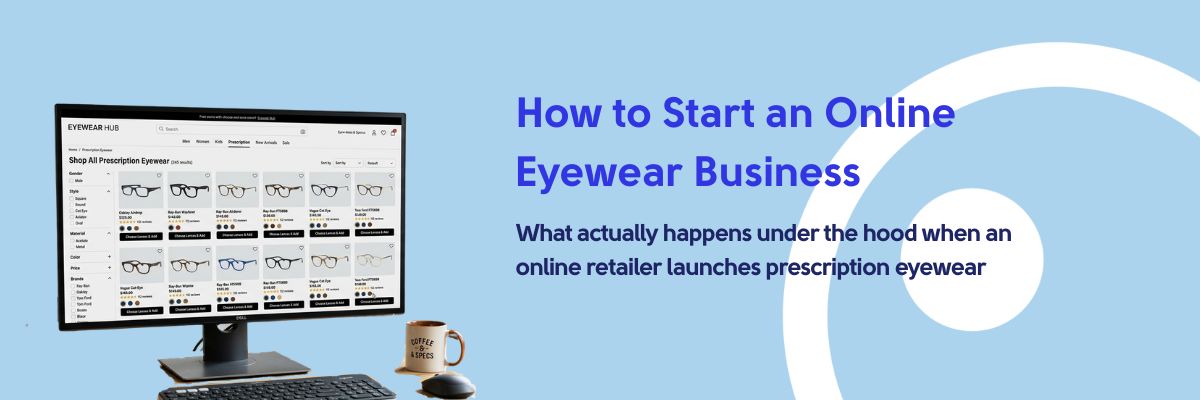
How to start an online eyewear business in 2026: the operator's guide
When an online retailer launches prescription eyewear, the first month usually looks fine. The catalog goes live, the early orders trickle in, the team relaxes. The trouble shows up later, around month three, when returns climb past 18% and someone on the team starts quietly asking whether the category was a mistake in the first place.
The category is not the mistake. The Rx flow is.
Most teams treat prescription input as a checkout step, but it is not a checkout step at all. It is the engine of the entire operation, the layer where every PD error, every unvalidated axis, and every missing add power eventually compounds into a remake, and every remake compounds into margin loss.
The retailers that scale eyewear understand this early. They treat the Rx flow as the product, and the frame as the wrapper that carries it.
Eyewear is not just another category
An online eyewear business in 2026 is not a fashion store with lenses bolted on. It is an operationally coupled stack where the catalog feeds the configurator, the configurator feeds the constraint engine, and the constraint engine feeds the lab routing, in that order, every single order. Pull one piece out and the others stop working.
Most teams treat the stack as nine separate vendors. It is one system.
The four layers that decide whether the category compounds
1. Catalog
You need depth, not just breadth. A working online eyewear store carries thousands of frames across price tiers, fits, materials, and shapes, with the metadata that downstream systems actually need: bridge width, lens height, temple length, hinge type, lens compatibility. Without that metadata the configurator cannot reason about what is buildable. Building a catalog without inventory is the only way to reach this depth without locking up working capital.
2. Configurator and Rx flow
This is where most launches quietly fail. A good configurator collects sphere, cylinder, axis, add power, and pupillary distance with validation rules that catch the obvious errors at input time, not at the lab. PD measurement online alone accounts for a meaningful share of remakes when it is treated as an afterthought. Pair the configurator with virtual try-on and the abandonment rate at the prescription step drops from the 50–60% range to something the business can actually live with.
3. Constraint engine
Not every frame works with every lens, and not every lens works with every prescription. A high minus prescription in a large rimless frame is a remake waiting to happen. The constraint engine sits between the configurator and the lab, refusing combinations that will not produce a clean lens. Without it, the lab refuses orders after the customer has already paid, and the operations team spends its week issuing apologies.
4. Lab routing and fulfillment
One lab is a single point of failure. A network of certified labs routes each order based on prescription complexity, lens type, geography, and capacity. The customer sees one brand. The operation runs on 12.
What actually breaks at scale
- Returns above 18% almost always trace back to the Rx flow, not the frame.
- Cart abandonment above 50% at the prescription step means the configurator is asking for what the customer cannot easily provide.
- Margin compression in month four is usually remakes, not pricing.
- Support tickets exploding in month six is the constraint engine missing, the lab refusing combinations the configurator accepted.
None of these are catalog problems. All of them are operational coupling problems.
The five mistakes new entrants keep repeating
We covered these in detail in the five biggest mistakes in online Rx eyewear, but the short version is: treating Rx as a checkout step, picking a single lab, skipping virtual try-on, ignoring PD validation, and underestimating the constraint engine. Each one looks like a corner you can cut. None of them actually are.
Who can run this without optical expertise
Pharmacies, marketplaces, fashion brands, and online retailers all launch prescription eyewear without an optician on staff. The system carries the optical knowledge so the team does not have to. We walked through this in how to sell Rx eyewear without being an optician and in the pharmacy operator playbook.
What a working launch looks like
A working launch in 2026 looks boring on the surface. The catalog is live with 17,000 frames. The configurator validates every prescription before the customer pays. Virtual try-on is on every product page. PD measurement is built into the flow. The constraint engine quietly refuses the orders that would have failed. Lab routing picks the right lab for each prescription. Returns sit below 8%. The team spends its week growing the channel, not apologizing for it.
That is not a content stack. That is an operating system for an eyewear business.
Where to start
If you are a pharmacy, the entry point is GoHub for pharmacies. If you are a brand or reseller, start with GoHub for brands and resellers. If you want to evaluate the customer-facing layer first, the virtual try-on and PD measurement tools are the fastest way to feel what a working Rx flow looks like end to end.
Get the system right and the category compounds.
Frequently asked questions
What makes eyewear different from other e-commerce categories?
It is an operationally coupled stack rather than a fashion store with lenses added. The catalogue feeds the configurator, the configurator feeds the constraint engine, and the constraint engine feeds lab routing, in that order, on every order. Pull one piece out and the others stop working.
What are the four layers that decide whether the category works?
The catalogue, with the metadata downstream systems need such as bridge width, lens height and lens compatibility. The configurator and prescription flow. The constraint engine that knows which lens works with which frame. And lab routing and fulfilment.
What breaks at scale, and when?
Returns above 18% almost always trace back to the prescription flow rather than the frame. Cart abandonment above 50% at the prescription step means the configurator is asking for what the customer cannot easily provide. Margin compression in month four is usually remakes rather than pricing. Support tickets exploding in month six is a missing constraint engine.
Who can run an online eyewear business without optical expertise?
Online retailers adding a revenue line, online pharmacies expanding beyond contact lens solution and readers, eyewear brands and frame resellers wanting prescription fulfilment for their direct channel, dropshippers, and independent opticians scaling beyond a physical store.