 March 25, 2026
The 5 Biggest Mistakes in Online Prescription Eyewear Sales
Prescription eyewear e-commerce converts at under 1%.
Fashion e-commerce averages 2 to 3%. Electronics sits higher. Even luxury goods outperform.
The demand is there. The global Rx eyewear market is worth $140B. Consumers want to buy glasses online. They search for it. They land on product pages. And then they leave.
That's not a traffic problem. That's a friction problem.
After working with retailers across Europe launching prescription eyewear categories, the same five mistakes appear again and again. Every one of them is fixable. And fixing them can double or triple conversion rates.
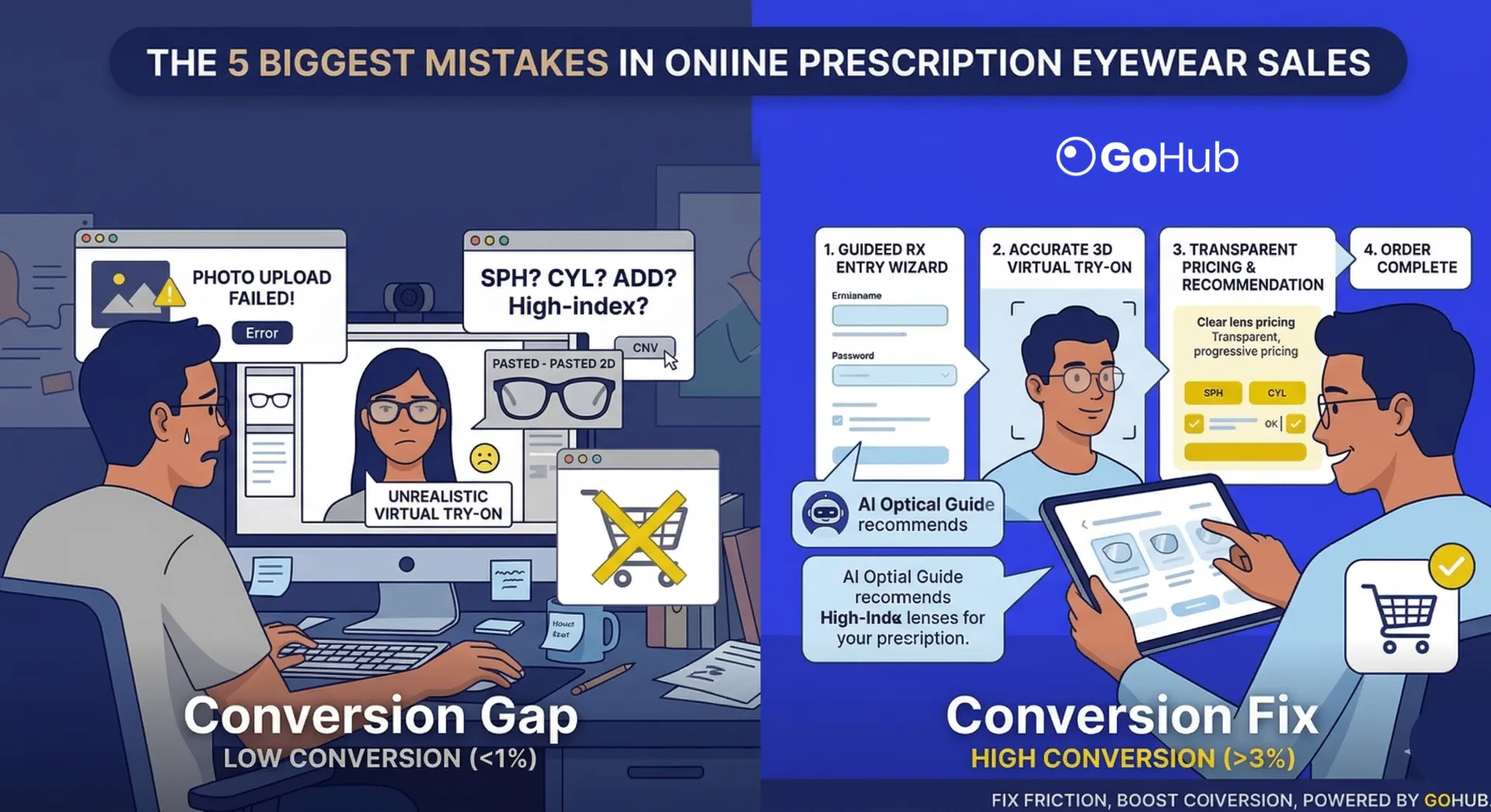
Mistake 1: Forcing Prescription Photo Uploads
Most online eyewear stores ask customers to upload a photo of their prescription. A scan, a phone picture, a PDF from their optometrist.
This sounds simple. It's not.
Prescriptions come in dozens of formats. Handwritten. Printed. Abbreviated. Different countries use different conventions. Customers don't know what "SPH," "CYL," or "ADD" mean. They don't know if their prescription is still valid. They don't know if the uploaded image is readable.
The result: confusion, hesitation, and drop-off.
What works instead: A guided prescription entry wizard that walks the customer through each field, validates inputs in real time, flags potential errors, and explains what each value means. GoHub's prescription wizard does exactly this, reducing Rx-entry abandonment by over 50% compared to photo upload flows.
Mistake 2: Virtual Try-On That Looks Nothing Like Reality
Virtual try-on should build confidence. In most implementations, it destroys it.
The problem: most VTO tools are 2D overlays. A flat image of a frame pasted onto a webcam feed. Proportions are wrong. The frame doesn't track head movement naturally. Lighting doesn't match. The customer looks at the result and thinks, "this can't be right."
That doubt is a conversion killer.
What works instead: 3D-rendered VTO that maps facial geometry in real time. Accurate proportions based on head shape, nose bridge width, and ear position. Natural head tracking. Realistic lighting and depth. No app download. Under two seconds to load.
GoHub's 3D virtual try-on has been benchmarked against every major competitor in the market. The quality gap is structural, not cosmetic. When customers trust what they see, they buy.
Mistake 3: Hiding Lens Pricing Until Checkout
Prescription glasses are not a $29.99 product. Depending on the prescription, lens material, and coatings, the total can range from $80 to $400+.
Many online stores show the frame price upfront and reveal lens costs only at checkout. The logic: get the customer invested before showing the full price.
The reality: this is the fastest way to kill trust.
A customer who selects a $120 frame, spends 10 minutes configuring lenses, and then sees a $280 total at checkout doesn't feel informed. They feel tricked. And they leave.
What works instead: Transparent, progressive pricing from the start. Show the lens cost impact as the customer makes each selection. "Single vision lenses: +$40. Anti-reflective coating: +$25. Progressive lenses: +$90." The customer builds the price themselves. No surprises.
GoHub's lens configurator shows real-time pricing at every step. Retailers using this approach report significantly lower checkout abandonment than those using reveal-at-checkout models.
Mistake 4: No Guidance on Lens Options
Single vision. Progressive. Bifocal. Blue light filtering. Photochromic. Anti-reflective. High-index. Polycarbonate.
For an optician, these are routine categories. For a consumer buying glasses online for the first time, this is a wall of jargon.
Most online stores present lens options as a product configurator: dropdowns, checkboxes, feature comparison tables. No context. No recommendation. No explanation of why a customer with a -6.00 prescription should choose high-index lenses, or why a customer who works 10 hours a day at a screen should consider blue light filtering.
The customer freezes. Or worse, they guess wrong and receive glasses that don't work for their lifestyle. Then they return them.
What works instead: AI-powered lens recommendations based on the customer's prescription, age, lifestyle, and usage patterns. GoHub's AI Optical Assistant, built for independent opticians and digital-first eyewear retailers, asks the right questions and recommends the right lenses, explaining the reasoning in plain language. The same guidance a trained optician would provide in-store.
The result: higher confidence, higher AOV (customers buy recommended upgrades they understand), and lower return rates.
Mistake 5: Treating Rx Eyewear Like a Standard Product
This is the root cause behind every other mistake on this list.
Prescription eyewear is not a commodity. Every order is custom-manufactured. The product is a medical device. The purchase involves entering sensitive health data. The customer needs to trust that the measurement, the prescription interpretation, the lens production, and the fitting will all be correct.
Retailers who bolt a prescription flow onto a standard e-commerce product page are treating Rx eyewear like a t-shirt with extra fields. That approach fails.
What works instead: A purpose-built Rx purchase journey that acknowledges the complexity. Guided prescription entry. PD measurement. VTO. Lens recommendation. Transparent pricing. Order tracking. Post-purchase support.
This is what GoHub provides as a single platform. Not a collection of widgets. A full Rx commerce infrastructure that handles the prescription wizard, VTO, PD measurement, AI lens guidance, lab fulfillment, and compliance in one integration.
The Conversion Gap Is an Execution Gap
The $140B prescription eyewear market is moving online. The demand exists. The technology exists. The customer willingness exists.
What's missing, in most cases, is execution.
Retailers who fix these five mistakes see conversion rates jump 2 to 3x. The ones who move first own the category in their market. The rest lose to competitors who figured it out earlier.
GoHub exists to close that gap. One integration. Full Rx category. Live in days.
The retailers who treat prescription eyewear as a serious category, not a feature request, will win. The rest will watch.
GoHub turns any e-commerce store, from pharmacies and drugstores to fashion marketplaces, into a fully compliant online optician. 17,000+ frames. 100+ brands. 12 certified labs. No inventory. No optical expertise required. Learn more at goptichub.com.
Related reading: Why Most Virtual Try-On Tools Disappoint (And What to Look For).
Frequently asked questions
Why do online prescription eyewear stores convert so poorly?
The article puts prescription eyewear conversion under 1% against 2 to 3% for fashion e-commerce, and argues the gap is an execution gap rather than a demand problem. Customers search for glasses, land on product pages, and leave because the buying experience does not answer the questions they need answered.
What is wrong with asking customers to upload their prescription?
Prescriptions arrive in dozens of formats, handwritten or printed, abbreviated differently by country, and customers do not know what SPH, CYL or ADD mean or whether their prescription is still valid. A guided entry wizard that validates each field in real time works better. GoHub's wizard reduces prescription entry abandonment by over 50% compared with photo upload flows.
Why does poor virtual try-on hurt conversion rather than help it?
Most tools are 2D overlays, a flat frame image pasted onto a webcam feed with wrong proportions, no natural head tracking and mismatched lighting. The customer sees the result and concludes it cannot be right, so a feature meant to build confidence destroys it instead.
Should lens pricing be shown before checkout?
Yes. Prescription glasses are not a fixed price product, and depending on prescription, lens material and coatings the total can range widely. Showing the frame price upfront and revealing lens costs only at checkout produces abandonment at the last step.